Our Solutions
SIMUFLIGHT’S SIMULATOR OFFERINGS

SIMULATOR MANUFACTURING
Aviamech provides comprehensive simulator manufacturing solutions tailored to meet the rigorous demands of the aviation training industry. Specialising in high-quality, state-of-the-art simulators, Aviamech designs and builds simulators that replicate the real-world experience with impressive precision. Our simulators cover a wide range of aircraft, from single-engine propeller powered aircraft to advanced jets and helicopters, catering to the diverse needs of pilots and training institutions.
Aviamech’s manufacturing process combines cutting-edge technology with expert craftsmanship to ensure that each simulator meets global standards. The emphasis is placed on ergonomic design, high-fidelity visuals, and realistic flight controls, allowing trainees to experience immersive, authentic training sessions. In addition, Aviamech supports clients with customisation options, enabling them to select specific features and systems that match the aircraft and training scenarios they require.
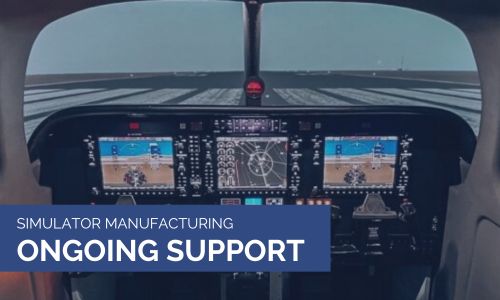
Alongside manufacturing, Aviamech provides after-sales support, including maintenance and software updates, ensuring that simulators remain at peak performance. This commitment to quality and support has established Aviamech as a trusted partner in aviation training across Africa and beyond.

The development and manufacture of a type-representative or type-specific flight simulator is a highly specialised process involving a range of engineering disciplines, detailed accuracy in replication, and rigorous testing to meet both technical and regulatory standards. This type of simulator is designed to replicate the flight experience with sufficient fidelity to allow pilots to receive training and certification in an environment that closely mirrors real flight conditions.

1. Initial Research and Data Collection: The process starts with in-depth research on the target aircraft type or class, including aerodynamics, performance specifications, flight controls, systems, and avionics.

2. Simulator Design: Using 3D CAD tools the complete simulator is designed virtually before component manufacturing data is created.

3. Software and Flight Dynamics Modelling: The flight simulator software is programmed to replicate the aircraft’s performance and handling characteristics under various conditions. This involves complex mathematical modelling and simulation techniques to mimic the aircraft’s response to different inputs, atmospheric conditions, and flight manoeuvres

4. Visual Systems and Environmental Simulation: Advanced graphics and visual displays are used to create realistic external views for the pilot. High-resolution, immersive screens and projectors are implemented to simulate weather conditions, terrain, lighting, and other environmental factors.

5. Hardware and Cockpit Integration: A replica of the cockpit is built to match the dimensions, control placements, and instrumentation of the real aircraft. Controls, switches, gauges, and displays are engineered for accurate tactile feedback, often using the same or similar materials as the aircraft. This allows trainees to develop muscle memory that will be directly applicable to the actual aircraft.

6. Testing and Qualification: After the simulator is assembled, it undergoes extensive testing to ensure that it meets industry standards, often governed by regulatory authorities such as the SACAA, FAA or EASA. Testing includes a series of subjective evaluations that include manoeuvres, system checks, abnormal, and emergency procedures to verify that the simulator’s response closely matches that of the real aircraft. Qualification is required for the simulator to be approved for pilot training.

The manufacturing of a flight simulator involves close collaboration between engineers, software developers, and manufacturing experts. Each component, from the cockpit structure to the visual system and motion platform, if applicable, is precision-engineered and assembled. Final assembly of the simulator includes accurate calibration processes before delivery to the training facility.
Once complete, a type-representative or type specific flight simulator serves as a critical tool for pilot training, reducing the need for in-flight training hours, enhancing safety, and providing a platform for training on emergency procedures and new scenarios. The level of realism provided by these simulators is essential for preparing pilots, making them an invaluable asset in modern aviation training programs

Our Direct Projection Cylindrical Visual System delivers an exceptionally immersive experience, offering a sweeping 250° horizontal field of view designed to match the natural perspective from the pilot’s viewpoint. This advanced setup integrates a continuous cylindrical projection screen with cutting-edge laser projectors and specialized software, seamlessly blending individual projections into a single, unified image.
The results are clearer visuals, continuous field of view, and unmatched realism that draws the crew fully into each training scenario. This enhanced visual fidelity supports everything from VFR circuit training to complex scenario-based sessions, providing a true-to-life environment that elevates training outcomes.
Experience training that feels real, so your crew is fully prepared when it matters.
At Aviamech, our commitment to realistic and high-fidelity simulation is complemented with rigorous, hands-on flight data gathering when required. Our flight data campaigns are meticulously designed and conducted on aircraft instrumented to capture data that is not available in the Pilot’s Operating Handbook or Aircraft Flight Manual. This includes unique data that characterises an aircraft’s handling and flight dynamics.
Each data-gathering campaign is tailored to deliver insights that drive realism. Once collected, the data undergoes thorough processing, analysis, and reformatting to ensure it meets the standards required for simulator fidelity validation. This approach helps us create training environments that truly reflect the unique behaviour of each aircraft.
Our experience spans diverse aircraft, including the Beechcraft 1900D, BAE Jetstream JS41, Cessna C208 Grand Caravan, Piper Seneca III, and Bell 222UT.
Reach out to explore how our data expertise can elevate the accuracy and reliability of your simulators.

At Aviamech, we understand the unique demands of cabin crew training and the critical role training simulators play in ensuring passenger and crew safety. While our core focus is on simulators to train pilots, we’re proud of our growing expertise in rebuilding and upgrading cabin crew door training simulators.
Each simulator upgrade project we undertake is guided by a commitment to safety, reliability, and authenticity, tailored to meet the real-world scenarios that cabin crew may face. Our engineering team works closely with our clients, listening to their needs and understanding the specific challenges their crews face. By combining technical excellence with a customer-first approach, we’ve helped enhance training programs that are as rigorous as they are realistic.
We take pride in creating training solutions that go beyond the technical. Every simulator we rebuild reflects our dedication to the professionals who rely on them daily – providing them with confidence, skill, and readiness. Contact us for more information

Aviamech’s Consulting Services support the specialised needs of the flight simulation industry, offering tailored expertise to help you navigate complex challenges and regulatory demands.
Our consulting team can assist with:
With our deep industry knowledge and hands-on experience, Simuflight and Aviamech’s consulting services are designed to keep your operations efficient, compliant, and future-ready.
Contact us to discuss your requirements.